
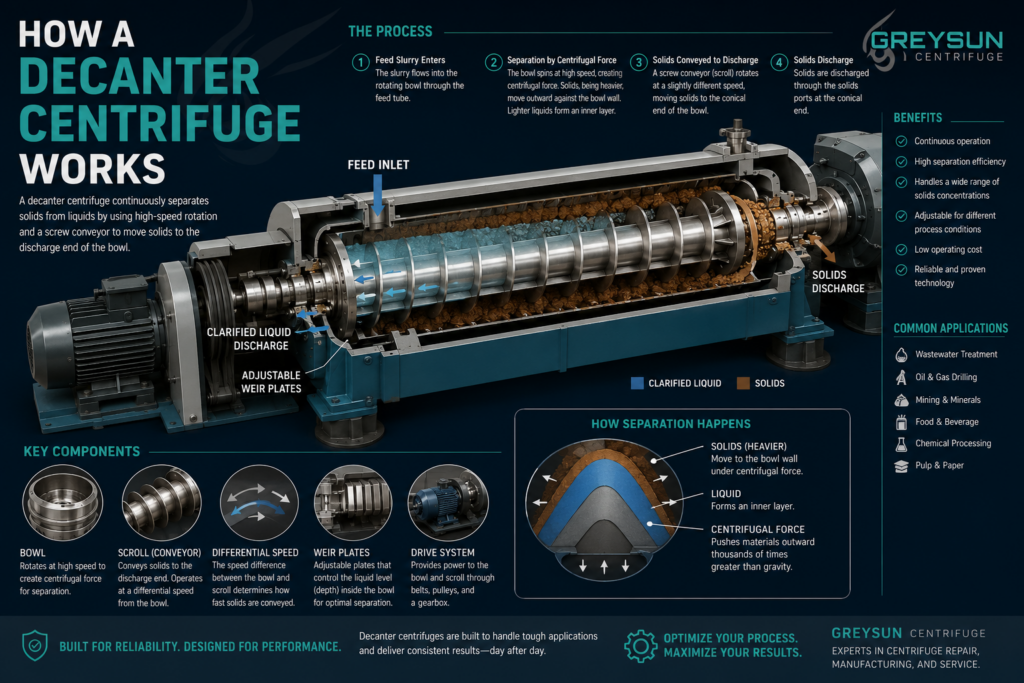
A decanter centrifuge is a continuous-flow separation machine used to separate suspended solids from liquids. It is commonly used in wastewater treatment, oil and gas, food processing, chemical manufacturing, mining, environmental services, and many other industrial applications.
Unlike filtration equipment that relies on screens or filter media, a decanter centrifuge uses high-speed rotation to create centrifugal force. This force separates materials according to differences in density.
The Basic Principle
The centrifuge contains a horizontal cylindrical bowl that rotates at high speed. As the bowl spins, it generates centrifugal force that can be thousands of times stronger than gravity.
The process material, often called slurry, enters the rotating bowl through a feed tube. Because the solid particles are generally heavier than the liquid, they are forced outward and settle against the inside wall of the bowl. The lighter liquid forms a separate layer closer to the center of the bowl.
A rotating screw conveyor, also called a scroll, continuously moves the separated solids toward the discharge end of the centrifuge. The clarified liquid flows toward the opposite end, passes over adjustable liquid weirs, and exits the machine.
This allows the centrifuge to continuously receive feed material, separate the solids and liquid, and discharge both phases without stopping the process.
Main Components of a Decanter Centrifuge
Rotating Bowl
The bowl rotates at high speed and creates the centrifugal force required for separation. Its diameter, length, shape, and operating speed all influence capacity and separation performance.
Scroll or Conveyor
The scroll is positioned inside the bowl and rotates at a slightly different speed. Its purpose is to move the settled solids toward the solids discharge openings.
Feed Tube
The feed tube carries the incoming slurry into the centrifuge. The material enters the rotating assembly and is accelerated to bowl speed.
Drive System
The drive system powers the rotating bowl and conveyor. Depending on the machine, this may include motors, belts, pulleys, gearboxes, and hydraulic or electronic control systems.
Gearbox or Backdrive
The gearbox helps maintain the speed difference between the bowl and the scroll. This speed difference is known as differential speed.
Liquid Weirs
Adjustable weirs control the depth of the liquid pool inside the bowl. Changing the pool depth can affect clarification, solids dryness, and overall centrifuge performance.
Solids Discharge
Separated solids are conveyed out of the bowl through discharge openings. Depending on the application, the discharged material may range from a wet sludge to a relatively dry cake.
How the Separation Process Works
- Feed Introduction
The slurry is pumped into the centrifuge through the feed tube. It enters the rotating bowl and quickly accelerates to the bowl’s operating speed.
- Solids and Liquids Separate
Centrifugal force pushes the heavier solid particles toward the bowl wall. The lighter liquid remains closer to the center, creating separate solids and liquid layers.
- The Scroll Conveys the Solids
The scroll rotates at a slightly different speed than the bowl. This difference allows it to move the settled solids toward the conical end of the bowl.
- Solids Are Discharged
As the solids move along the bowl, they travel out of the liquid pool and across the beach section. The separated solids are then discharged through openings at the end of the bowl.
- Clarified Liquid Exits
The separated liquid flows toward the liquid discharge end of the centrifuge. It passes over adjustable weirs and exits the machine for further processing, reuse, or disposal.
What Is Differential Speed?
Differential speed is the difference between the rotational speed of the bowl and the rotational speed of the scroll.
Although both components rotate rapidly in the same direction, the scroll turns slightly faster or slower than the bowl. This small difference allows the scroll to convey solids through the machine.
Differential speed has a major effect on performance. A higher differential speed generally moves solids through the bowl more quickly, while a lower differential speed increases the amount of time the solids remain inside the centrifuge.
The correct setting depends on the feed material, solids concentration, desired cake dryness, throughput, and process goals.
Factors That Affect Centrifuge Performance
Several operating conditions influence separation quality:
Bowl speed
Differential speed
Feed rate
Feed concentration
Liquid pool depth
Solids particle size
Temperature
Viscosity
Chemical conditioning
Scroll design
Bowl geometry
These settings must work together. Increasing one setting may improve one part of the process while reducing performance somewhere else. Proper centrifuge operation requires balancing throughput, liquid clarity, solids dryness, wear, and energy use.
Advantages of a Decanter Centrifuge
Decanter centrifuges are widely used because they offer several important benefits:
Continuous operation
High processing capacity
No disposable filter media
Compact equipment footprint
Adjustable operating parameters
Consistent solids and liquid separation
Ability to process varying feed conditions
Automated operation
Reduced labor requirements
Reliable performance in demanding applications
Common Applications
Decanter centrifuges are used in many industries and processes, including:
Municipal and industrial wastewater treatment
Sludge dewatering
Drilling fluid processing
Oil recovery
Food and beverage processing
Chemical production
Mining and mineral processing
Rendering
Biofuels
Pulp and paper
Agricultural processing
Environmental remediation
The correct centrifuge configuration depends on the material being processed and the required separation results.
Why Proper Selection and Setup Matter
A decanter centrifuge must be properly sized and configured for the application. A machine that is too small may not provide enough capacity or separation time. A machine that is too large may require unnecessary power and operating expense.
The bowl design, scroll configuration, wear protection, drive system, materials of construction, and control system should all be selected based on the process requirements.
Proper setup also matters after installation. Bowl speed, differential speed, feed rate, and pond depth may need to be adjusted as process conditions change.
Maintenance and Reliability
Routine maintenance is essential for safe and reliable centrifuge operation. Important maintenance areas include:
Bearings
Seals
Gearbox lubrication
Belts and pulleys
Wear protection
Scroll flights
Solids discharge areas
Vibration levels
Bowl condition
Drive alignment
Abnormal vibration, reduced performance, unusual noise, temperature changes, or increased bearing readings may indicate that the centrifuge requires inspection or service.
Regular inspections and preventive maintenance can reduce unexpected downtime, extend equipment life, and help maintain consistent separation performance.
The Greysun Approach
At Greysun Centrifuge, our experience goes beyond equipment sales. We manufacture, repair, remanufacture, and support industrial centrifuges across a wide range of applications.
Because our team has spent decades inspecting and rebuilding centrifuges, we understand where wear occurs, how failures develop, and what design improvements can simplify maintenance and improve reliability.
Whether you need help selecting a centrifuge, improving an existing process, sourcing replacement parts, or repairing damaged equipment, Greysun can provide a solution tailored to your operation.
Need Help With Your Centrifuge Application?
Greysun Centrifuge provides new equipment, repair services, remanufacturing, replacement parts, field support, and custom-engineered separation solutions.
Contact our team to discuss your process requirements, operating challenges, or centrifuge service needs.